
SMOKING
Tobacco is unique; the only product that kills when used entirely as intended (Action on Smoking and Health [ASH], 2003). It was introduced to Europe from the New World at the end of the fifteenth century. Smoking spread rapidly and was long regarded as having medicinal value. It was not until the 20th century, however, that smoking became a mass habit and not until after the Second World War that the dangers of smoking were firmly established. The Tobacco Advertising and Promotion Act became law in the UK in February 2003 and tobacco cannot be advertised on billboards, on television, or in the press. This is estimated to save 3000 British lives every year (Cancer research, 2003a).
Smoking is one of the most significant causes of preventable disease and early death in the UK. Every year it is estimated that around 120,000 people die as a result of smoking, which equates to over 300 people a day (Cancer Research, 2003b).
Health Risks and Statistics
In Britain around a quarter of the adult population smoke, approximately 15 million (Cancer Research, 2003c). Smoking is most common in young people, with the research (Cancer Research, 2003c) showing that 40% of men and 35% of women in the 25-34 age bracket smoke.
Smoking kills around six times more people in the UK than road traffic accidents, (3,391), other accidents (8,933), poisoning and overdose (3157), murder and manslaughter (495), suicide (4,485), and HIV infection (180) put together (20,641 in total) (Office for National Statistics, 1999). In the United Kingdom about 450 children start smoking every day (Cancer Research, 2003a).
Smoking causes thirty per cent of all cancer deaths (including at least 80% of lung cancer deaths), 17% of all heart disease deaths and at least 80% of deaths from bronchitis and emphysema.
Smoking and Disease
A number of diseases can result from smoking (ASH, 2001):
Cancers:
Lung, mouth, lip and throat, oesophageal, bladder, kidney, stomach, pancreatic, liver, colorectal and cervical cancers and leukaemia.
Heart and circulation:
Ischaemic heart disease, aortic aneurysm, myocardial degeneration, atherosclerosis and stroke.
Others:
Bronchitis, emphysema, pneumonia, stomach and duodenal ulcers.
Increased risk for smokers:
Gum disease, Buerger’s Disease, duodenal ulcer, osteoporosis (in both sexes), osteoarthritis, erectile dysfunction, impotence (2 x risk), peripheral vascular disease (90% of cases), Crohn’s Disease (chronic inflamed bowel), depression, psoriasis (2 x risk), skin wrinkling, stomach ulcer, influenza, and tuberculosis.
Function impaired in smokers:
Ejaculation (volume reduced), sperm count reduced, sperm motility impaired, sperm less able to penetrate the ovum, sperm shape abnormalities increased, fertility (30% lower in women), immune system (impaired), menopause (onset 1.74 years early on average).
Symptoms worsened or diseases more severe in smokers:
Asthma (increased sensitivity and reduced lung function), Graves’ Disease (over-active thyroid gland), chronic rhinitis (chronic inflammation of the nose), multiple sclerosis, diabetic retinopathy (eyes), optic neuritis (eyes), common cold, influenza, pneumonia, Crohn’s Disease (chronic inflamed bowel), tuberculosis.
What is in a Cigarette and Why is it Harmful?
Cigarettes contain more than 4000 different chemicals (Cancer Research, 2002), of which at least 400 are toxic substances, and 60 are known or suspected carcinogens (cancer causing substances) (United States Environmental Protection Agency, 1992).
Smoking Cessation
Seven out of ten adult smokers say they would like to give up if they could, but most find this incredibly difficult (Cancer Research, 2003a). A cycle of change model has been developed to help support those who wish to stop smoking.
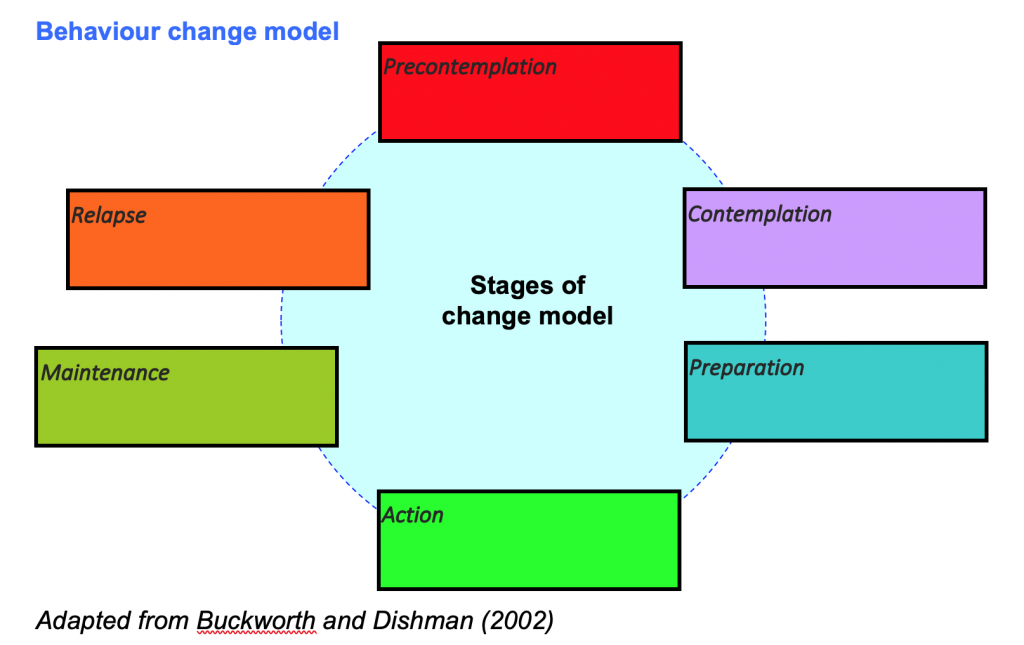
Pre-contemplation:
This stage occurs when individuals are still smoking and have no serious intention of stopping smoking. This stage requires that information regarding smoking is readily available.
Contemplation
This stage occurs when an individual is still smoking but is intending to stop smoking within the next six months. This stage requires the provision of realistic goals and ideas to stimulate compliance to a non-smoking regime.
Preparation
During this stage individuals are planning to make specific changes or are experimenting with small changes. It is this stage that the individual is most likely ready for change.
Action
This stage is the most important in terms of giving feedback and support, as this tends to be the most difficult time. They will see and feel changes in their body and state of health but may reach a plateau and need motivating to carry on.
Maintenance and relapse
This stage will require motivation, support, the reinforcing of goals and monitoring. This is the most unstable stage as motivation can be difficult to maintain at the required levels.
Relapse
The trainer will need to offer more support to prevent relapse.
Beneficial health changes when stopping smoking:
Stop smoking and the body will begin to repair the damage done almost immediately, kick-starting a series of beneficial health changes that continue for years (US DHHS, 1990).
| Time since quitting | Beneficial health changes that take place |
| 20 minutes | blood pressure and pulse rate return to normal |
| hours | nicotine and carbon monoxide levels in blood reduce by half, oxygen levels return to normal |
| hours | carbon monoxide will be eliminated from the body lungs start to clear out mucus and other smoking debris. |
| 48 hours | there is no nicotine left in the body ability to taste and smell is greatly improved. |
| 72 hours | breathing becomes easierbronchial tubes begin to relax and energy levels increase |
| 2 – 12 weeks | circulation improves |
| 3 – 9 months | coughs, wheezing and breathing problems improve as lung function is increased by up to 10% |
| 1 year | risk of a heart attack falls to about half that of a smoker |
| 10 years | risk of lung cancer falls to half that of a smoker |
| 15 years | risk of heart attack falls to the same as someone who has never smoked |
References
Action on Smoking and Health (2001). Homepage. http://www.ash.org.uk/
Action on Smoking and Health (ASH) (2001). Smoking statistics: Illness and Death.http://www.ash.org.uk/html/factsheets/html/fact02.html
Buckworth, J. Dishman, R. (2002). Exercise Psychology. Human Kinetics.
Cancer Research (2003a). Tobacco- Children. http://www.cancerresearchuk.org/news/publicaffairs/tobacco/children
Cancer Research (2003b). Tobacco. http://www.cancerresearchuk.org/news/publicaffairs/tobacco/
Cancer Research (2003c). Tobacco- Adult. http://www.cancerresearchuk.org/news/publicaffairs/tobacco/adult
Cancer Research (2002). Reducing Your Risk. http://www.cancerresearchuk.org/aboutcancer/reducingyourrisk/9288
Office for National Statistics (1999). Mortality statistics 1998. Statistics & Research Agency.
United States Department of Health and Human Services (US DHHS) (1990).The Health Benefits of Smoking Cessation: A report of the Surgeon General. http://www.cdc.gov/tobacco/sgrlist1.htm
United States Environmental Protection Agency (US EPA) (1992). Respiratory health effects of passive smoking. EPA/600/6-90/006F, http://www.epa.gov/iaq/pubs/etsfs.html